
Dear visitor,
If you are looking at buying a Persian rug from an online seller or from a rug retail store, please take a moment and look over these tips.
Whether you are new to Persian rugs or already have some knowledge and experience, it is very important to know what to look for and what to avoid when shopping for a Persian carpet. Over the past 20+ years, I have received many e-mails and phone calls from folks who have seen Persian rugs being offered and the question often asked is how to tell if they are described accurately and how to make sure that they are not taken advantage of. Unfortunately, there are many Persian rug online and retail businesses that are using very deceptive methods and promises, which is why this trade has earned such a bad reputation. In the last couple of years I have also noticed that more and more online sellers are using the same gimmicks as regular retail stores and some have taken this a step further by misrepresenting the rugs they offer. Most sellers know that odds are that the buyer knows too little or take full advantage of the fact that the buyer can not see the rug in person and are at the mercy of the sellers words.
To help you guide through the confusion of buying a Persian, I have made a list of tips that I think will help you.
Tip #1: Pay with a credit card or use payment options like PayPal
This may sound like a given since most of us shop online, but keep in mind that in most countries credit cards and online payment systems like PayPal offer insurances in case of theft or fraud as well as automatic return rights. If you are looking at buying a rug at a local business or from private party, make sure that you have some sort of buyer's protection in writing in case you decide later that you want to return it.
Tip #2: MSRP - Big Warning Sign!! ==> Likely Scam!!
If a rug seller states that a handmade Persian rug has a MSRP, ask them for the barcode and the manufacturer!! Handmade Persian rugs are priced based on their type, quality, type of wool and so on. The M in MSRP stands for Manufacturer and the only rug sellers that state MSRP's are typically the ones that also offer the rugs then at savings of up to 70% or more to make it look like you are getting a great deal and typically don't actually know anything about the rugs they are selling.
Tip #3: Be aware of large online rug websites
If an online retailer offers tens of thousands of rugs, chances are they don't actually have the rugs in their inventory and are offering the rugs of others.
It is common that wholesalers provide pictures of their rugs to retail and online sellers who then sell the rugs and act as if the rugs are part of their inventory. This is not a big deal unless you are looking at buying a high quality rug where knowledge and professionalism should be expected.
One of the easiest ways to know if a rug seller actually has ever seen the rug or knows anything about it is for you to call them and ask them to send you some additional pictures. Since my family is a premier supplier of fine Persian rugs to many retailers, I can tell you all about how many sellers advertise our rugs in their sites, but I have to watch what I say...
Tip #4: VERIFY QUALITY - YES, YOU CAN DO IT!!
One of the biggest scams that rug sellers apply is to exaggerate the quality of the rugs they are selling. Whether it is selling 50 Raj Tabriz rugs as 60 Raj, 9-Lah Nain rugs as 6-Lah and so on.
Amongst the most common deceits that many rug sellers apply is to lie about the knot count of rugs, which is one of the most important ways for you to know if the rug is what it is or not. And yes, you can verify the quality of a rug even if you are not an expert or are buying a rug online. Look for the details of the rug and somewhere you will see a magical number that will show whether the seller has any integrity or is lying to you. The thing to look is the KPSI or KQM, which stands for Knots per Square Inch in the US and Knots per Square Meter outside the US. If you buy a rug online, you should always see a picture with a ruler and if it's not there, ask for one. The knot count is to rugs what horse power is to cars. Typically the higher, the more expensive and the more luxurious, but there are a few exceptions. Naturally, many sellers like to either round up (never down) the numbers or completely lie about them.
How to count the KPSI for my American clients and knots per square meter for everyone else
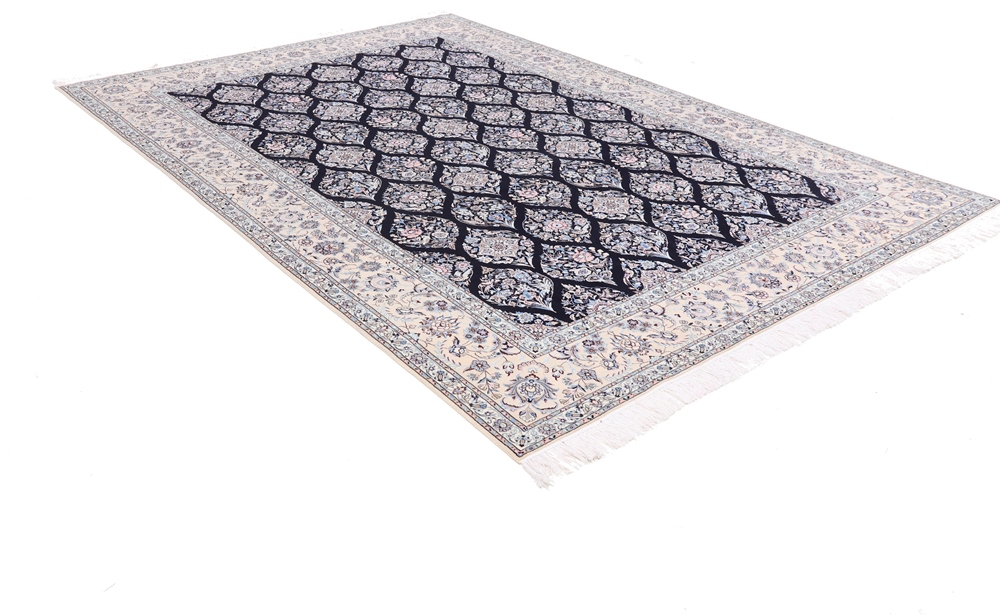
Here is how to solve the problem. Tell the seller that you want to see a close up picture of the back of the rug with a ruler in case you don't already see it. Now, two things will happen. The seller will take the picture and e-mail it to you or he will he will delay for whatever reason. If he cannot provide you with a picture of the back of the rug, chances are that he is offering rugs that are not in his actual possession and has simply posted pictures of rugs from others. I discussed this in my previous tip. Here is an example of one of my high quality Nain carpets and both pictures are of the same rug.
Do yourself a favor and save your eyesight. If you can, open the picture using a photo software which chances are you already have in your computer or simply zoom it on your phone. Increase the viewing % and I typically increase it to either 150 or 200 depending in the size of the picture. Now all you need to do is count the knots over the distance of one inch. For example, the picture of the left shows a Nain rug and on the right is the close-up picture with a ruler of the back of the same rug. Now just count the knots over 1 inch and square the number and you get ~500, that's it. You got the KPSI. Compare what you see to what the seller claims and see for yourself. Now, please note that most retailers including myself do not get on our knees and check the knot count of every rug. We know that a certain type of rug should have a certain kpsi and there will always be some variance, but it should be a small variance and not a huge one. I state in my description that this Nain rug has a 6-Lah quality with about 500kpsi, which is about right. If the rug had in reality 300 kpsi, then I would either be trying to con you or I'm incompetent.
How to count the knots per square meter for my non-US visitors: Take a ruler and count the knots over 5cm. Then double the number and add a zero behind it. You now have the approximate knots over one meter and simply square that number. That will give you an estimated knot count over one square meter and its a great way of telling whether the seller is legitimate or not...
Tip #5: BEWARE OF FAKE SILK RUGS!!

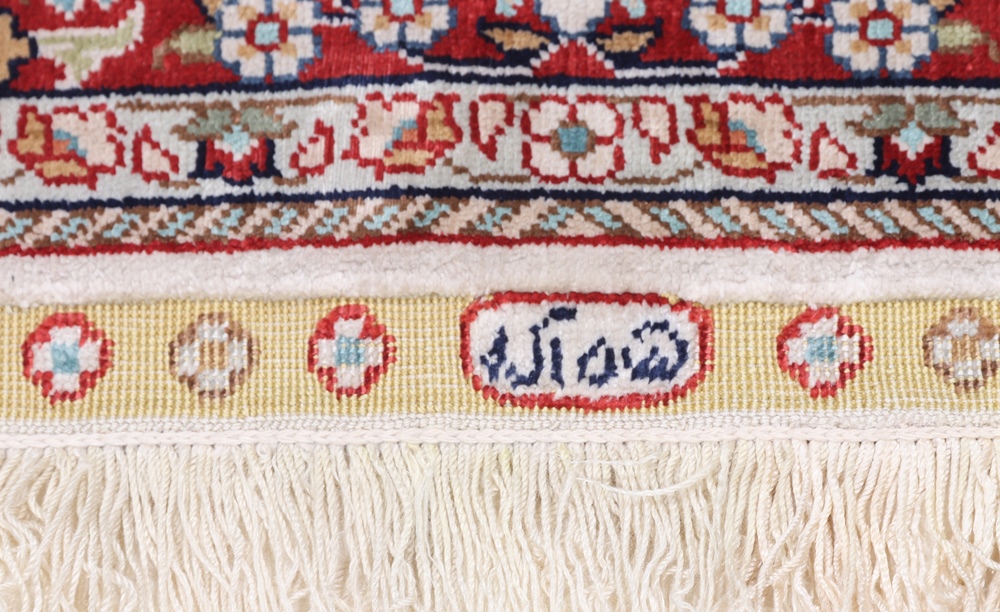
If you look at my website, this Hereke rug is clearly marked as a Chinese Hereke rug in my website and I have no problems recommending it based on its quality and price.
HOWEVER, I do know for a fact that several rug dealers are offering this rug as a genuine Turkish Hereke rug and that is FRAUD!!!
IMPORTANT VIDEOS ABOUT SILK RUGS
In my Youtube channel, you will find several videos where I talk about real vs. fake silk rugs, and please check them out if you are in the market for a genuine silk rug. Please note that I am not trying to make myself sound like an expert, but after over 20 years of getting emails and calls from rug owners and having to deliver them bad news about their rugs, I felt it necessary to make the videos and hope they are of help to you.
My YouTube Channel with videos about real vs. fake Persian Rugs
Tip #6: SIGNATURES: Don't pay extra for them!!
Many Persian rugs and especially the high end pieces like the fine Nain and pure silk Qum rugs feature signatures and while they are a nice novelty, they typically do not add value or demand a higher price. Note the Nain rug that you above with the ruler. That piece like so many other Nain rugs features the Habibian signature even though it is a new rug and Habibian has been dead for over 25 years. The Habibian weaver is one of the most famous Persian rug weavers and his name has become synonymous with fine Nain rugs, but they are not real. The same goes for pure silk Qum rugs and many other type of Persian rugs. A signature in a rug is a nice thing to see, but if a seller pushes its value and makes a big deal about it, they better be some darn good explaination for it. Again, this is something that I discuss in several of my videos.
Tip #7: Be careful with stated rug qualities
This goes alongside the point I made earlier about the kpsi and has to do with the listed quality type by many rug sellers. For example, we have noticed that there are some rug dealers who list our 55 raj Tabriz rugs as 60 Raj pieces on their site or take the pictures of our 9-Lah Nain rugs and advertise them as finer 6-Lah. I can give you a ton of actual examples of rugs that are nowhere near the quality that the sellers claim and that is why I always tell my clients to listen to the seller with a skeptical ear. The quality of the rug should match the type of rug and if in doubt, walk away.
Tip #8: ASK QUESTIONS!!
Sounds to easy, but you will be amazed by how many of my clients have purchased rugs without asking any questions other than how to pay. The more you ask, the better you get to know the seller and always follow your gut instinct. Since I own an internet business, I rarely get to meet my clients in person, but I can get to know them fairly well just by talking on the phone and by exchanging e-mails. It is also important to know if the rug fits your needs. I personally like to get to know my clients so that I can make sure they are getting the right rug for the right reasons.
Well, I hope that these pointers will help you and that you enjoyed your visit. Please feel free to let me know if you think something should be added or changed and I wish you a pleasant experience
finding that special rug and many years of pleasure admiring it.
Sincerely,
Mike Panah


